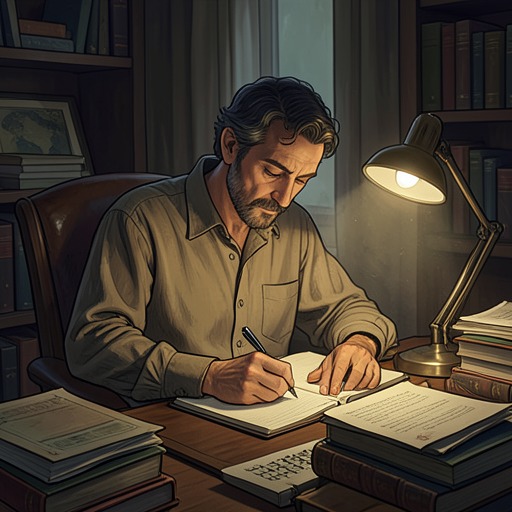
William Chester Minor—James Murray: OED collaboration and friendship
The Surgeon of CrowthorneWilliam Chester Minor and James Murray were linked first by the Oxford English Dictionary and then by a friendship that lasted for decades. Their relationship joined an extraordinary flow of scholarly contributions to the circumstances of Minor’s confinement at Broadmoor Asylum. Murray initially knew him only as a diligent reader; learning the truth did not end their correspondence, but made tact and personal trust central to it. Their actual first meeting, in January 1891, was quieter and earlier than the celebrated story later told about it.
A Collaboration Begins
When work on the Dictionary became difficult over the word art, Murray’s team sought further evidence. Sixteen shades of meaning had been identified, and a request went to Broadmoor asking whether Minor had quotations that might indicate additional senses or earlier usage. Eighteen readers responded to the appeal. Minor’s reply was the most substantial: he supplied twenty-seven quotations, against the sentence or two offered by the other correspondents. His response showed the Oxford team that he was meticulous, prolific, and able to draw on deep reserves of reading and research.
A quotation from Sir Joshua Reynolds’s Discourses provided the first point of connection. The contribution belonged under the sense relating to the arts, but its importance soon exceeded the particular entry. Minor continued to work for the Dictionary for the next two decades, while the scholarly link grew into a relationship marked by mutual respect and gratitude. Their shared interest in words gave the two men a durable point of contact even though their circumstances and temperaments differed.
Minor’s contribution was not occasional. He sent quotations at a prodigious rate, sometimes more than a hundred new slips in a week and as many as twenty in a day, all written in his neat, firm hand. His letters to Murray were generally formal and concentrated on the Dictionary, with personal matters rarely entering them. The discipline of that correspondence made Minor’s scholarship legible to Murray before Murray knew the full story of the scholar himself.
Knowledge, Disclosure, and Tact
Murray’s first contact with Minor came soon after he began working on the Dictionary, probably in 1880 or 1881. He later recalled that Minor proved a good reader who wrote often. Seeing the address Broadmoor, Crowthorne, he assumed that Minor might be a medical officer at the institution rather than an inmate. For years he corresponded with him without understanding his position.
Murray eventually learned the truth through Justin Winsor, the American librarian and historian, who told him about Minor. The account contained errors: Murray later repeated that Minor had attended Harvard rather than Yale and included a possibly apocryphal story about an execution after a court martial. It also misplaced the London shooting in the Strand rather than the Lambeth waterside. But Winsor conveyed the essential fact that Minor had committed a murder and was confined at Broadmoor. Murray was deeply affected, yet feared that revealing his knowledge might alter their relationship. He chose instead to write more respectfully and kindly than before, without indicating that anything had changed in what he knew.
Murray hesitated to visit because he had no reason to think Minor knew that his correspondent had learned about him. An American visitor who had seen Minor said that he was low in spirits and would welcome a visit. Murray then wrote to Minor, explaining that he had heard a visit would be welcome, and separately sought permission from Dr Nicholson, the governor. This indirect, careful approach reflects the delicacy with which Murray tried to preserve Minor’s dignity while moving their relationship beyond letters.
The First Visit and the Friendship
The meeting took place in January 1891, six years earlier than the date assigned to it in the popular story. Murray travelled with permission from Dr Nicholson, who met him at the railway station, drove him there and back, and invited him to lunch with Minor. Murray spent many hours with Minor in his room or cell, before and after the meal. He found him cultivated and scholarly, with artistic interests and a fine Christian character. In Murray’s assessment, Minor seemed sane; he was resigned to his lot and grieved chiefly over the restrictions it placed on his usefulness.
Murray also learned that Minor gave a large part of his income to support the widow of the man whose death he had caused, and that she regularly visited him. The detail placed their scholarly relationship in a wider moral context: the man Murray admired for his learning was also living with the consequences of a killing, and attempting, in a sustained practical way, to aid the bereaved family. Dr Nicholson thought highly of Minor, granted him privileges, and sometimes brought distinguished visitors to see him and his books. These circumstances helped make the visit possible, though Nicholson’s successor was less personally sympathetic.
The friendship that began over lunch rested on wary mutual respect as well as their shared love of words. Their first sight of one another carried an odd suggestion of recognition: both were tall, thin, bald men with hooded blue eyes and long white beards. The resemblance was not exact—Minor’s beard was more unkempt, Murray’s carefully groomed—but it gave their meeting the appearance of two scholars confronting near-reflections of themselves. In later years they met dozens of times, and their personal acquaintance continued regularly for almost twenty years from that first visit.
Visits, Moods, and Mutual Regard
Their meetings depended in part on Minor’s changing moods. Murray learned to ask Dr Nicholson how Minor was before setting out from Oxford. If Minor was low and angry, Murray would stay away; if he was low but likely to be comforted by a visit, Murray would take the train. This practical attention to Minor’s condition shows the friendship not as an abstract bond but as a relationship shaped by the realities of life at Broadmoor.
When the weather was poor, they sat together in Minor’s small, plainly furnished cell. Its bookshelves held the works on which much of the Dictionary depended, with the rarest sixteenth- and seventeenth-century volumes kept behind glass. Tea and Dundee cake might be brought by an inmate Minor had hired, one of several privileges Dr Nicholson allowed him. Minor could order books from antiquarian dealers in London, New York, and Boston, write uncensored letters, and receive visitors. He told Murray with some pride that Eliza Merrett visited his rooms frequently. Such ordinary details of reading, hospitality, and conversation formed the setting for a collaboration sustained inside an institution.
The Corrected Story and Lasting Bond
A dramatic version of the first meeting obscured the more gradual history. In 1915, journalist Hayden Church published a romanticized account in which Murray supposedly set out to visit a fellow scholar and discovered at the institution that Minor was an American murderer and inmate. The story appeared first in an American newspaper and then, revised and expanded, in the Strand. It captivated readers during the Great War and became the version repeated in many later accounts of Dictionary-making.
The fuller record emerged in a 1902 letter Murray wrote to Francis Brown in Boston, later found in a wooden box among the possessions of one of Minor’s few living relatives. Murray’s account establishes that he knew Minor personally and visited him from January 1891, not for the first time six years later as Church’s story suggested. The correction does not make their meeting insignificant; it restores its actual character. Their friendship began not in a single theatrical revelation but through years of scholarly exchange, a considerate disclosure, and repeated visits. The work that started with a quotation for art endured for decades, keeping the two men connected through both the Dictionary and a shared devotion to words.